

On Job Dissatisfaction

There are several reasons why employees stay in a job. According to Hertzberg (1959) in his two-factor theory, job satisfaction is divided into two factors – hygiene factors and motivators. For this post, I’ll focus on hygiene factors.
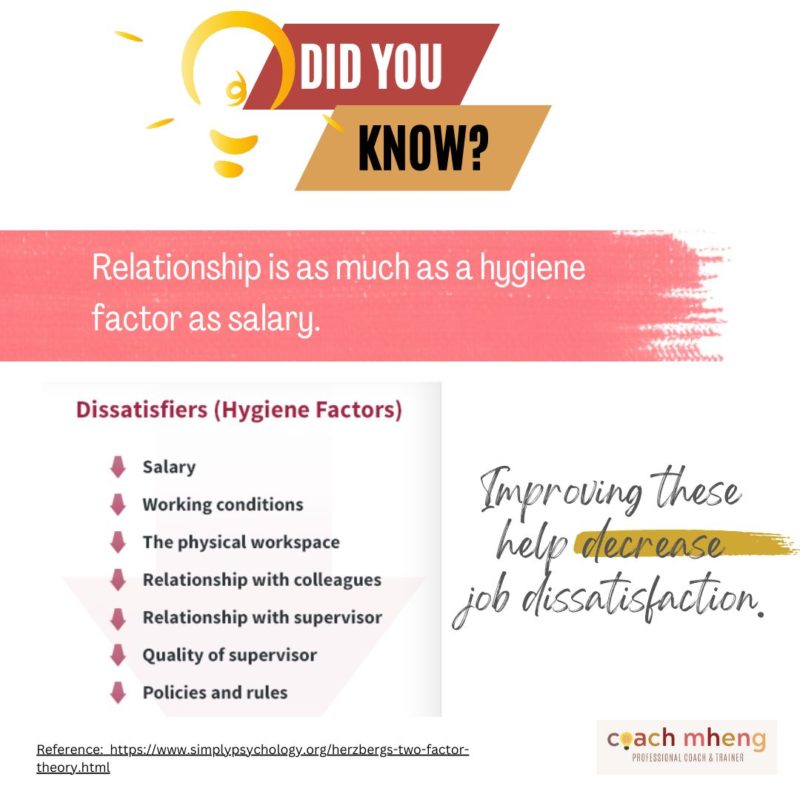
Hygiene factors are the minimum requirements that need to be met to avoid “unpleasantness” in a job. When not met, they become “dissatisfiers” that cause employees to complain. The point that I want to drive here is that there are several hygiene factors. What comes to mind so easily is salary. But along with salary are working environments and relationships with colleagues and supervisor.
Key takeaways:
1. Organizations can invest on other factors apart from salary to decrease job dissatisfaction.
2. Investing on leaders is a must. It can be as much a source of complain as salary.
3. Complains are dissatisfier detectors. Instead of seeing them negatively, organizations can value them as a way to improve hygiene factors.

A look at the 2022 DepEd budget shows 477.33B on compensation and benefits and just 1.93B on professional development and 5.95 on Basic Education Facilities. I totally agree paying our educators well. They should be receiving fair compensation. My hope is that DepEd sees the value of investing in other hygiene factors apart from salary. There are other factors that needs investments like improving classroom size and facilities, upskilling of supervisors, and making policies and rules more efficient. When addressed, it will not just make our teachers more satisfied in their job but also make our students more engaged in learning.

About Post-Pandemic Education

To be honest, when the move to go full face-to-face was announced, I wasn’t supportive.  In addition to my doubts over safety, I am a proponent of blended learning.  I believe that there is so much value in online learning that we need to maximize.  But that is because I teach in a private school and I know we can afford to do blended learning.  For the public school, the best way to mitigate the impact on learning is to go full face to face.  But that alone is not enough. Doing 5 days of classes will not get students back to their reading or numeracy level.  Schools and families have to do more.  We have to make learning happen faster and more meaningfully.  And we have to work together.
Here are some ways we can do it for young learners.
– Focus on fewer rather than more.  It may be counterintuitive to give less but giving students more at this point will simply overwhelm them.  Choose lessons that target really important skill sets – reading, writing and numeracy.
– Integrate. Make lessons thematic.  Put together reading with Araling Panlipunan lessons.  Integrate writing with ESP lessons.  Integrate lessons in your everyday interactions.

Why Coaching in Education is a Big Win

I had been in the field of education for 12 years prior to joining APEC Schools. I have taught in several schools both here and abroad and in both the elementary and secondary levels. I had been a classroom teacher, a class adviser, a subject coordinator, and a teacher trainer. I could really say that I have done much in the academe that it is so easy to believe that we have tried almost everything with regard to improving the quality of the field. That was until I was introduced to Coaching.

I was first introduced to coaching through interactions and research in APEC Schools. We are fortunate to be managed not only by educators, but by people from various industries. And from them came the knowledge that once previously is only known from the world of business – they knew about coaching.

Our leaders were coached and in their own rights were coaching as well. They used it in their past companies in handling their people. They were also professionally developed using the same approach. They knew it worked and the benefits attached to it.