
As a Master Certified Coach (MCC) through the International Coaching Federation, Teresa has been providing leadership development training & coaching for nearly 15 years.
She believes deeply that coaching in its many forms is one key to changing behaviors and creating lasting change and impact.
We offer the following coaching services:
- Indvidual and team coaching
- Group and peer coaching
- Individual and group mentor coaching
- Coaching skills training for managers and leaders
- Creating coaching cultures in organizations
Individual coaching is a one-on-one relationship that supports and challenges individuals to stretch and grow their leadership capacity. With the support of a coach, the client engages in meaningful goal setting, honest and truthful exploration about opportunities and about what gets in the way of reaching goals, practicing new skills and behaviors, and accountability for trying something different.
Several things can inform individual goal setting including client goals and career aspirations; role expectations; feedback from a manager or supervisor; a 360-degree assessment of manager(s), peers, and/or direct reports, and/or other assessments.
Assessments offered: Gallup Clifton Strengths, CoreStrengths Strengths Deployment Inventory (SDI) 2.0, interview-based 360-degree assessment.
Group coaching is a collaborative approach to leadership development where multiple individuals come together to participate in coaching sessions. Unlike individual coaching, which focuses on personal growth, group coaching leverages the collective experiences, insights, and feedback of the group members. A professional coach facilitates the sessions, guiding the group through discussions, exercises, and activities designed to enhance leadership skills, foster peer learning, and build a supportive network. This format allows participants to learn from each other’s successes and challenges, gaining diverse perspectives on leadership practices and strategies.
There are multiple benefits of group coaching. Participants benefit from a shared learning environment that encourages collaboration and mutual support, which can lead to stronger professional relationships and a sense of community. The diverse viewpoints and experiences within the group foster innovative thinking and problem-solving. Additionally, group coaching provides a cost-effective way for organizations to develop multiple leaders simultaneously, ensuring a more cohesive leadership culture. Through regular interactions and collective goal-setting, leaders become more self-aware, improve their communication and collaboration skills, and are better equipped to implement organizational changes effectively.
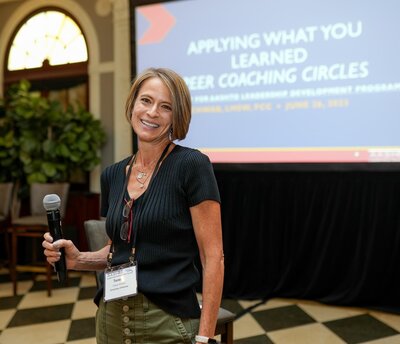
Peer Coaching is another model for group coaching. Peer coaching starts with individuals learning coaching skills and then encourages people to engage in coaching each other. Peer coaching strategies can be structured in a number of ways, including a highly structured process called Peer Coaching Circles. In partnership with our colleagues at Ad Adstra Coach Alliance, we have developed a Peer Coaching Circle model that has been used successfully in multiple organizations and settings.
Mentor coaching is specifically for coaches who want to improve their coaching skills.
Having a independent credentialed coach listen to your coaching and provide assessement and feedback against the International Coaching Federation (ICF) core competencies is critical to growth and development as a coach. Teresa’s goal as a mentor coach is to be direct, specific, and kind in her delivery of feedback. You will walk away from mentoring sessions knowing precisely what you do well and what you need to work on to improve your skills as a coach.
We offer both group and individual mentor coaching. Groups consist of a maximum of 10 participants and are scheduled 1-2 times per year.
Data shows that people don’t leave organizations, they leave people. People in organizations that have responsibility to manage, supervise, or lead others have a great deal of power to influence whether people choose to stay or go. They are a major leverage point in any organization, and smart organizations invest in their managers and supervisors and encourage them to develop strong relationships that help others learn, grow, and succeed in their roles.
Using coaching as an approach to working with others is a compelling strategy to increase employee engagement.
Coaching is a mindset, a skillset, and a process.
Mindset
Approaching others as smart and capable and trusting them to do what they were hired to do is a way to develop a strong relationship foundation. From there, the manager becomes a partner rather than a solution provider. The manager trusts others to find their own solutions and allows for the possibility of failure. In most cases, when things don’t work out exactly as desired or planned, there is a great opportunity to learn. When someone can “fail” and not be judged, it creates trust. When others are given space to name the real challenge, process through it, and then come up with their own path forward with an accountability plan, they are more likely to be bought into the action and more likely to follow through. The manager-employee dyad is a powerful leverage point in creating an organizational culture of engagement, motivation, autonomy, critical thinking, creativity, and innovation. All leading to happier employees and happier customers.
Skillset
Coaching utilizes tangible communication skills. When these communication skills are used from the foundation of the mindset above, the combination creates amazing results. Skills like presence, deep listening, curiosity, acknowledgement, and asking great questions help others feel heard and valued and help them think. When managers slow down, stop trying to solve everyone’s problems and challenges and instead listen to their employees, they help their employees think for themselves and build not only their engagement, but also their capacity to address future challenges.
Process
A coaching conversation has a specific flow. There is a beginning, middle, and end. It starts with truly understanding the issue, what the person wants instead, what is getting in the way of making progress, and then working through the barriers until a solution or path forward emerges. Once there is commitment to action, then together you build an implementation and accountability plan to make sure that action happens. This process allows you to have meaningful conversations that address the real issue while continuing to make forward progress.
Mindset, skillset, and process are all required to effectively use a coaching approach, and coming from training on tangible skills with extensive opportunities to practice, managers and leaders can implement what they have learned with immediately effective results.
We offer training in various lengths from 2 hours to 3 days.
Strong coaching cultures differentiate exceptional organizations.
A 2014 study by Human Capital Institute and the International Coaching Federation found that organizations that have strong coaching cultures report higher employee engagement and stronger revenue growth.
A coaching culture is more extensive than a simple coaching program. A coaching culture is one that believes in your employees as your greatest resource, and believes the best way to develop your people to be their best is by helping them think for themselves. Coaching is a mindset, a skillset, and a process. The mindset is one of positive regard and belief that people, when supported to think, try, fail/succeed and learn, will develop stronger skills and be more effective and more engaged in their work.
Through wide-spread, deeply infused training and application experience and support, anyone who manages or leads a team or effort is not only encouraged to approach people with this mindset, but they also learn specific skills required to be effective at developing their people to perform at their best. These include skills in approaching people and challenges with curiosity and non-judgement, checking biases and assumptions, listening deeply, acknowledging people, communicating directly, and asking really good, relevant questions. And finally, people learn HOW to have effective growth and learning conversations that begin by getting clarity about the problem, challenge, or opportunity and end by creating action steps with accountability structures to ensure progress. While coaching is ONE tool in a manager’s toolbelt, it is a powerful tool. When everyone in an organization uses coaching skills and approaches people as smart and capable, relationships gain strength, engagement and motivation go up, people become more creative and more invested, and accountability becomes the norm,
In addition to training and supporting managers and leaders to use coaching skills, organizations that develop strong coaching cultures also utilize external coaches to provide coaching and may also develop a team of internal coaches that have coaching others as part of their job descriptions.
Creating a coaching culture requires buy-in and leadership from the top of the organization and should filter all the way through the organization. Creating a coaching culture takes time and investment, but the pay-off is a kinder, smarter, more passionate, creative, innovative, accountable, and profitable organization.
We will partner with you every step of the way and help you design a strategy that will support your desire to stand out among the crowd, helping you draw and keep the best talent and perform at your best to meet your organization’s goals.
For more information about the data and impact of creating great coaching cultures check out the resources: https://coachingfederation.org/research/building-a-coaching-culture
Email teresa@arnavonstrategies.com to discuss your needs and how we can help you reach your goals.
What To Expect when Working with Teresa
I never want coaching to feel like a task to be checked off a to-do list. In contrast, coaching should always feel like something you look forward to. It is an opportunity to pause, come up for air, and think things through thoroughly. In a supportive, challenging, and confidential relationship, I will be your “thinking partner”. With my support, you will define what is meaningful and important to you, and we will work through the issue until we find a meaningful path forward.
Together, we will define success and set goals so that we can measure progress. You will walk away from each session with steps to take or things to try that will help you make progress on your goals.
I do truly believe that growth only happens in discomfort. There will be an element of challenge in our work together. There will be hard questions that challenge assumptions, biases, and belief systems that may be getting in your way.
About working with me, my clients say things like:
“Teresa listens better than anyone I know.”
“Teresa has a way of saying exactly what I’m thinking.”
“Teresa challenges me, but in a way I can hear.”
“Teresa asks me hard questions that really make me think.”
“Teresa has a way of distilling large, ambiguous challenges into clear, consise, and workable steps.”
“It is clear that Teresa has a deep understanding of the material, but also that she believes in its value. Her words changed my perspective.”
“Working with Teresa has been very engaging, enlightening, and beneficial. The insight I am gaining from our work together couldn’t have come at a better time.”
