Team coaching is a guided process that turns groups into aligned, resilient, high-performing teams.

Team Coaching
Organizations rarely succeed because of individual performance alone.
They succeed because teams learn how to think, decide, and act together effectively.
Team coaching helps leadership teams and intact work teams strengthen how they collaborate, align around shared goals, and deliver results that no individual could accomplish alone.
At Upstream Coaching, team coaching focuses on the quality of the team’s conversations, relationships, and shared responsibility for results.
When teams grow upstream, the impact flows throughout the organization.
What Team Coaching Helps Teams Do
Team coaching supports leadership teams and intact teams that want to grow in areas such as:
- Strengthening trust, openness, and psychological safety
- Clarifying shared purpose and collective priorities
- Improving decision-making and accountability
- Navigating conflict in healthy and productive ways
- Aligning around strategy and organizational goals
- Building stronger collaboration across roles and functions
- Developing the team’s ability to learn and adapt together
- Increasing the overall effectiveness of the team as a system
Team coaching is not about fixing individuals.
It is about helping the team become more aware of how it works together, and strengthening the habits that lead to sustained performance.
Who Team Coaching Is For
Team coaching is especially valuable for:
Executive Leadership Teams
Senior leaders responsible for organizational strategy, culture, and cross-functional alignment.
Leadership and Management Teams
Teams responsible for delivering results while navigating competing priorities and stakeholder expectations.
Cross-Functional Teams
Groups working across departments or disciplines who need stronger collaboration and shared ownership.
Teams in Transition
Teams experiencing leadership changes, growth, restructuring, or new strategic direction.

Signs Your Team May Benefit from Coaching
Many teams are filled with capable, committed people but still struggle to operate at their full potential.
Team coaching can be especially helpful when a team notices patterns such as:
-
Meetings that feel unproductive or circular
-
Important issues avoided or discussed outside the room
-
Lack of clarity around priorities or decision-making
-
Friction between departments or functions
-
Leaders working hard individually but not fully aligned as a team
-
Difficulty translating strategy into coordinated action
These situations are common in organizations.
Team coaching creates space for teams to step back, examine how they work together, and strengthen the way they move forward.
Team Coaching vs. Team Building
Team coaching is sometimes confused with team-building activities or facilitation.
While those can be valuable, team coaching focuses on something deeper.
Team building often emphasizes short-term activities designed to strengthen relationships.
Team coaching focuses on how the team works together over time while addressing real organizational challenges.
Rather than stepping away from the work, team coaching works within the work—helping teams reflect on their conversations, decisions, and patterns as they pursue meaningful goals.
The result is not just a better experience for the team.
It is stronger performance and healthier collaboration.
How Team Coaching Works
Team coaching typically combines team sessions, observation, and leadership conversations to strengthen the team over time.
A typical engagement may include:
- Discovery and Alignment
Understanding the team’s goals, stakeholders, and current challenges. - Team Coaching Sessions
Facilitated team conversations focused on real work, real decisions, and real dynamics. - Observation and Feedback
The coach may observe team meetings and provide reflections that help the team see patterns in how they operate. - Ongoing Development
Over time, the team develops stronger habits of communication, accountability, and shared leadership.
The goal is to be a more effective team.

Team Coaching Engagement Options
Every team and organization is different.
Team coaching engagements are designed to support the team’s real work, priorities, and challenges.
Most engagements fall into one of the following structures.
Leadership Team Coaching Engagement
Designed for executive or senior leadership teams that want to strengthen alignment, decision-making, and collective leadership.
A typical engagement may include:
-
Initial discovery conversations with key stakeholders
-
Observation of team meetings when helpful
-
6–10 team coaching sessions over several months
-
Reflection and integration between sessions
This approach allows the team to work on real strategic priorities while strengthening how the team collaborates and leads together.
Typical duration: 6–12 months
Team Effectiveness Engagement
Designed for intact teams that want to strengthen collaboration, communication, and shared accountability.
This engagement focuses on helping the team:
-
Clarify purpose and shared priorities
-
Strengthen trust and psychological safety
-
Improve decision-making and accountability
-
Develop healthier team dynamics
Typical structure:
-
Discovery and alignment session
-
4–8 team coaching sessions
-
Optional observation of team meetings
Typical duration: 4–8 months
Strategic Team Reset
Designed for teams experiencing transition, conflict, or significant change.
Examples include:
-
A new leadership team forming
-
Organizational restructuring
-
Strategy shifts or new priorities
-
Teams experiencing persistent tension or misalignment
This engagement provides structured space for the team to step back, strengthen relationships, and realign around shared goals.
Typical structure:
-
Discovery and assessment
-
2–4 intensive team coaching sessions
-
Follow-up integration session
Typical duration: 1–3 months
Team Coaching Investment
Team coaching is an investment in the effectiveness of the team responsible for delivering results.
Pricing varies depending on team size, engagement length, and organizational needs.
Team coaching engagements typically range from $3,500 to $15,000 depending on scope and duration.
Custom engagements can be designed to fit the specific needs of your organization.
The Upstream Approach to Team Coaching
Team coaching at Upstream Coaching is grounded in several key principles:
- The team is the primary client
- Real work is the best learning environment
- Teams grow when they reflect on how they work together
- Sustainable results come from stronger relationships and shared responsibility
- Healthy teams create healthier organizations
Rather than providing answers, the coach helps the team see itself more clearly, strengthen its conversations, and take more intentional action.
When Team Coaching Is Most Helpful
Organizations often engage team coaching when:
- A leadership team wants to become more aligned and effective
- A team is experiencing tension, silos, or communication challenges
- A new leadership team is forming
- A team must deliver results across complex stakeholder environments
- The organization wants to strengthen collaboration and culture
When teams learn to work better together, the results extend far beyond the team itself.
Professional Team Coaching
Team coaching at Upstream Coaching is informed by the work of leading team coaching thinkers such as Peter Hawkins and David Clutterbuck and aligns with the standards of the International Coaching Federation.
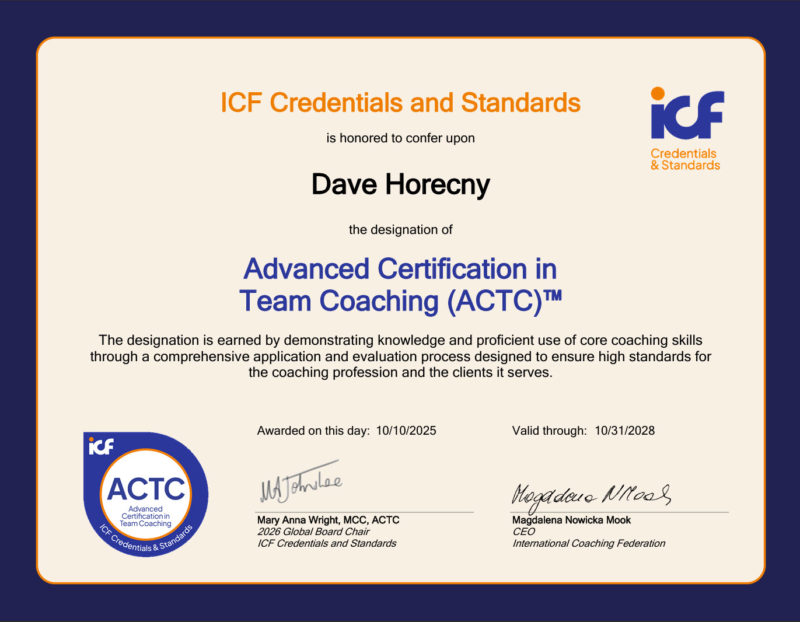
Dr. Dave Horecny is an ICF-credentialed coach and holds the Advanced Certification in Team Coaching (ACTC).
Ready to Strengthen Your Team?
If your team is ready to build stronger alignment, trust, and shared leadership, team coaching can provide the space and structure to make that possible.
Let’s start with a conversation.
